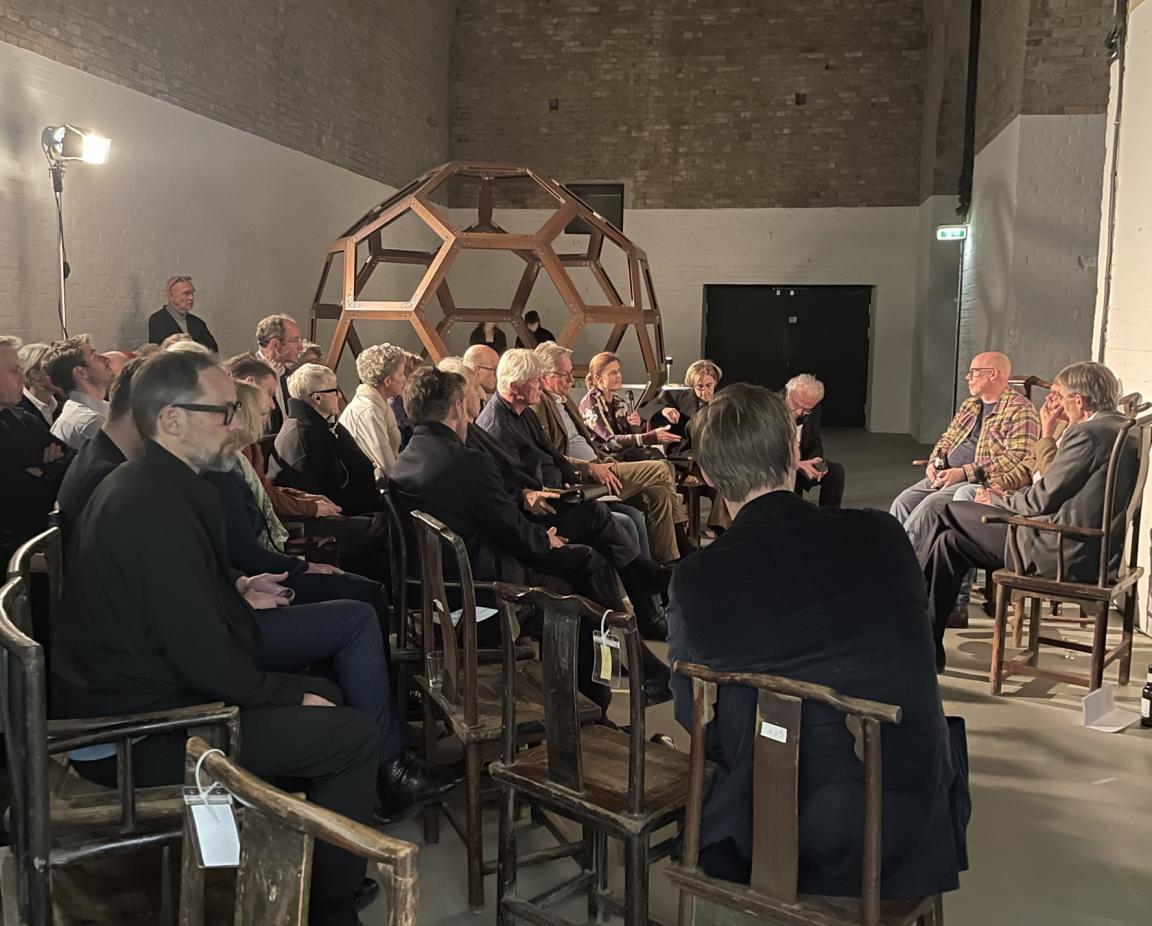
The enormous, vaulted spaces of the former brewery beneath Pfefferberg are cold. Aedes Gallery had invited guests to Ai Weiwei’s studio there. Harald Welzer kept the assembled architects waiting for a long time, before finally sending his perplexed audience, with their worried looks, off into an uncertain future.
In the end, none of these wonderful designers, deep underground, had a hopeful vision of their own future in the age of AI.
Several months have passed since that evening in the basement, and we have quite pragmatically begun integrating AI into our everyday work. At the office, we meet in the mornings for a few minutes, drink a cortado, and, taking turns, one team talks about its project. For some time now, we have been answering the question: “So, what have you done with AI?"
We hired an AI manager and a software developer. Once a week, the core team meets, twice a week the new applications are presented. Individual support accelerates the development.
The new software is just as helpful for taxes, personnel, and financial management as it is for research, planning, and communication. Meetings are recorded and transcribed. An AI agent answers project-related questions. Our tedious filing system is now a thing of the past.
For too long, architects have accepted spending a large part of their time searching for, coordinating, and checking information before translating it into the plans. With the new technology, these tasks can be completed quickly and precisely.
Often, solutions only work partially at first. With better prompts, skills, plugins, and automations, the results get better. At the same time, the LLM systems of the bros from California continue to evolve every 2–3 months.
We are now seeing the current AI assistant turn into a team of agents: the first checks areas and costs, a second compliance with building regulations, a third sustainability goals, and so on. They work quite independently and cross-check their results.
From an initial design, a variety of options can emerge, which have been simultaneously evaluated for spatial efficiency, construction costs, CO? emissions, daylight and permitability.
Alongside his human colleagues, a project manager has a digital toolbox of specialized agents to manage. With this, small teams grow wings. In this way, they can surpass the production power of today’s much larger offices.
This is a revolution. Because the same digital possibilities are available to everyone. A project developer will enter the site, planning regulations, floor area, construction costs, and return targets, and may be able to generate similar options themselves. What does this mean for project managers, structural engineers, building services engineers, or building performance engineers, when large parts of their work can be carried out by specialized agents?
Architects will still be successful in the future. If they create added value. If a task today requires three weeks, tomorrow three hours, they won’t be primarily rewarded for production drawings, but rather for careful decision-making: What should be built? Which idea, position, vision, societal concept underlies the project? Which of the machine-generated solutions are worthy of discussion. Diverse interests of clients, the city, users, consultants and the public must be weighed. Which solution can the urban community, public institutions, and clients stand behind? What is worth fighting for?
The more capable the machines become, the more important the responsible author, experienced decision-maker and designer become. How do his tasks change when a single architect has the workforce of ten, one hundred, or one thousand digital “coworker agents” at his disposal?
Software can soon draw, write and calculate. But it doesn’t have its own agenda. It cannot want a better building, a better city or a more humane society. The direction, the content, the longing and the will to pursue them are our responsibility.